Skip to content
Gainesville Foundation

Serving Gainesville and nearby areas

Cracks in Stucco Walls in Gainesville, FL

Cracks in stucco on a Gainesville home can be harmless or a sign the wall below is moving, and a free inspection tells you which one you have.

Book a free foundation inspection

Tell us what you are seeing. A local specialist calls you back the same business day.

Why houses move in Gainesville

Much of Gainesville sits on about five feet of sand over clay-rich soil, with limestone below that water slowly dissolves. Heavy summer storms soak the sand and wash it down into gaps in the rock. That is why the county sees sinkholes and settling under both old homes near downtown and newer slab homes on the west side.

  • Stucco right on the block

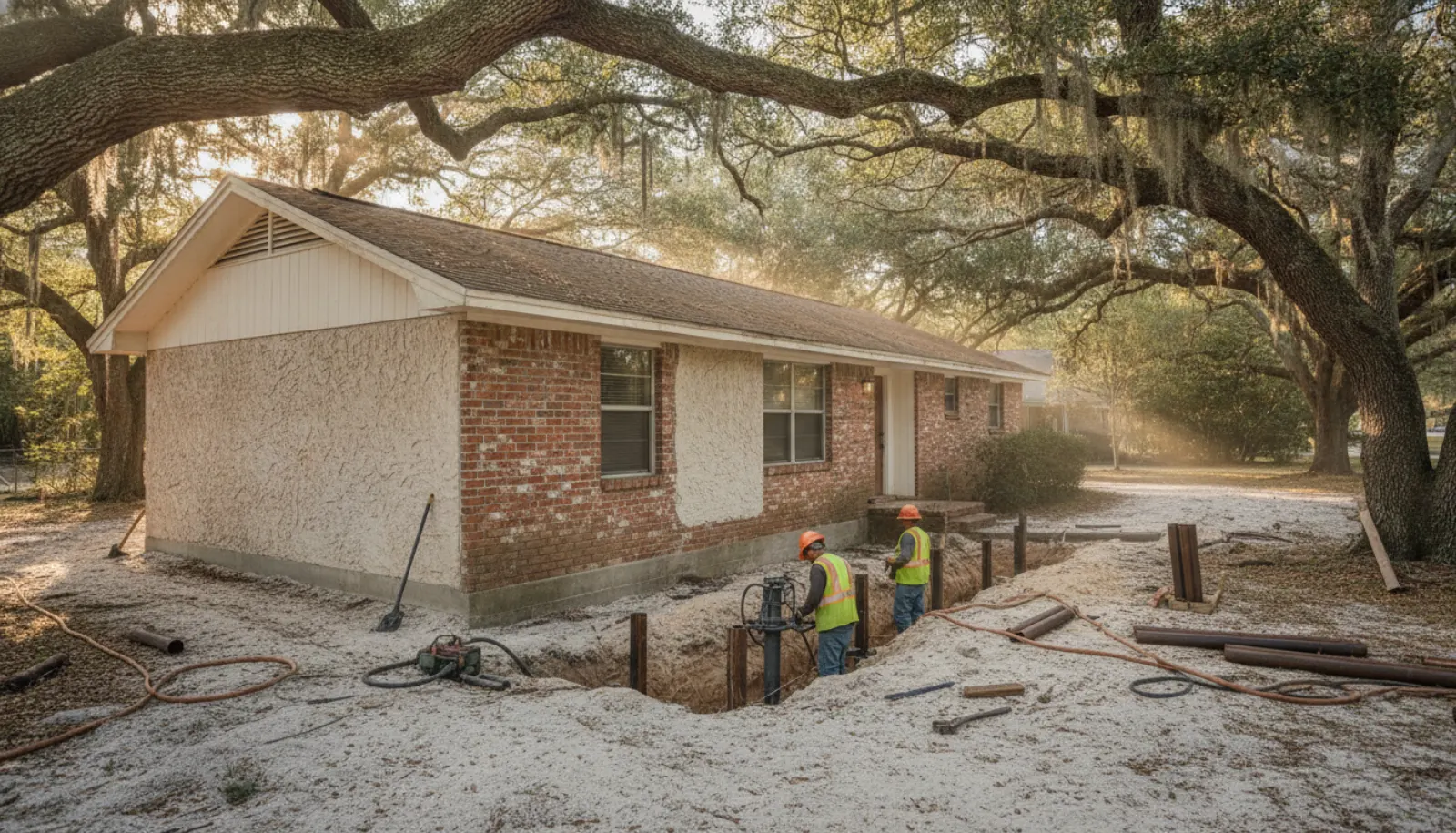
    Florida home inspectors note that stucco here is usually put straight onto the concrete block. When the block moves, the stucco cracks with it. That makes stucco a good early warning for what the wall is doing.

  • Homes with some age

    Half of the homes in Gainesville were built before about 1985, according to Census data. Forty years of wet summers and dry springs is plenty of time for small cracks to form and grow.

  • Sand that settles

    USDA describes common local soils as several feet of sand over a slower-draining clay layer. When sand under one corner packs down or washes out, the wall above it shows it first in the stucco.

What it costs

Typical published ranges for Gainesville. The contractor's written estimate is the price, and the inspection is free.

WorkTypical range
Inspection and written estimate Free
Stucco crack repair by a proThis Old House cost guide $8 to $20per sq ft
DIY crack sealing kitThis Old House cost guide $30
Piers, if the slab edge has sunkFixr 2026 $1,000 to $3,000each

See typical foundation repair prices in Gainesville

What stucco cracks look like

Stucco is the hard outer coat on many Gainesville homes. It does not bend. So when anything behind it moves, it cracks. That is why a crack in stucco is often the first thing an owner notices.

Not all of them mean the same thing. Here is what you may see on your walls.

Spider web cracks

Thin lines that branch out in a small patch. These often come from the stucco drying when it was put on.

Stair-step cracks

Cracks that zigzag along the block joints under the stucco, like steps.

Corner cracks

A crack that runs at an angle from the corner of a window or door.

Long straight cracks

One crack that runs up the wall or along it for several feet.

Wedge cracks

A crack that is wider at the top or the bottom than the other end.

Cracks near the ground

Breaks along the base of the wall where it meets the slab.

Cracks that come back

A crack that was sealed and painted, then opened again.

Why stucco cracks here

Most of the cracking you see in Gainesville comes from three things working together.

First, the block. Stucco here usually goes right on the concrete block. Block shrinks a little as it cures and moves a little with heat. Thin step cracks from that are common and usually not a worry.

Second, the sand. USDA soil surveys show many local yards have several feet of sand on top of a clay-rich layer. Sand drains fast. But when a lot of water runs to one spot, the sand under that part of the house can pack down or wash away. That corner drops a little. The stucco above it cracks.

Third, the rain. Gainesville gets about 48 inches of rain in a normal year, most of it in summer storms. Alachua County says the ground sinks most often in very wet spells that follow dry ones. Many owners first spot new stucco cracks in late summer.

There is one more cause that matters here. The limestone under Gainesville can open small gaps that sand drains into. That is less common than plain settling. But it is the reason a crack that keeps growing should not be ignored.

Cosmetic or urgent?

Most stucco cracks are cosmetic. Here is how to sort them.

Usually cosmetic

  • Hairline cracks you cannot fit a fingernail into.
  • Spider web cracks in one small patch.
  • Thin step cracks that look the same year after year.

Get it checked soon

  • A crack wider than about a quarter inch.
  • A wedge crack, wider at one end.
  • A crack that grows in length or width over a few months.
  • Corner cracks along with doors that started to stick inside.
  • Cracks on two or more sides of the house at once.
  • Stucco that bulges, sounds hollow or falls off in chunks.

Cracks that show up with inside signs are the ones to act on. A wall crack plus a sticking door plus a cracked tile in the same corner is a pattern. It usually means that part of the slab has moved.

How it gets fixed

The fix depends on what is behind the crack.

If the wall is not moving, the crack gets cleaned out, filled with a flexible patch and painted over. This is a stucco and paint job, not a foundation job. This Old House puts pro crack repair at about $8 to $20 per square foot. A small crack can often be sealed for the cost of a kit.

If the slab under that wall has dropped, patching alone will not last. The crack will just open again. The usual fix is piers set under the low part of the slab to lift and hold it. Then the stucco gets patched once the wall has stopped moving. Fixr puts piers at about $1,000 to $3,000 each. Most homes need several.

If water is the cause, the fix often starts with gutters, downspouts and grading. See drainage correction.

The inspector's job is to tell you which of these you need. That is why it pays to check before you patch.

What to do before the inspection

Measure

Mark both ends of each crack with a pencil and the date. Check them again in a few weeks.

Photograph

Take a photo with a coin or a ruler next to the crack for scale.

Look inside

Check the room behind the crack for sticking doors, drywall cracks or popped tile.

Walk the yard

Look for downspouts that dump next to that wall, or a low spot in the grass nearby.

Hold off on paint

Painting over a crack hides the evidence. Wait until you know what it is.

Free stucco crack check

Call (352) 724-7728 or send the short form. A local crew will come out, look at your cracks inside and out, and give you a written answer and price.

Frequently asked questions

Are stair-step cracks in stucco normal in Florida?

Thin ones often are. Home inspectors in Florida say stucco is put right on the block, and small step cracks show up as the block shrinks and settles. Cracks that widen, form a wedge shape or reach the top beam of the wall are a different story.

Can I just caulk the cracks and paint?

For thin cracks that are not growing, sealing them before you paint is the usual fix. If a crack comes back after it was sealed, This Old House notes that points to a deeper problem. Get it checked before you paint again.

Why do cracks start at the corners of windows?

Corners are the weak spot in any wall. When the wall shifts even a little, the stress goes to the corners first. A crack that runs at an angle from a window or door corner is one of the more common signs of movement.

How wide is too wide for a stucco crack?

A good rule is about a quarter inch. A crack you can slide a coin into, or one that is wider at one end than the other, is worth an inspection.

Will water get in through the cracks?

It can. Rain that gets behind stucco can soak the wall and stain paint inside. In a city with about 48 inches of rain a year, even small open cracks should be sealed.

(352) 724-7728 Free inspection