Skip to content
Gainesville Foundation

Serving Gainesville and nearby areas

Holes and Low Spots in the Yard in Gainesville, FL

A new hole or low spot in a Gainesville yard can be a sinkhole or simple settling, and a free inspection finds out which and whether your house is at risk.

Book a free foundation inspection

Tell us what you are seeing. A local specialist calls you back the same business day.

Why houses move in Gainesville

Much of Gainesville sits on about five feet of sand over clay-rich soil, with limestone below that water slowly dissolves. Heavy summer storms soak the sand and wash it down into gaps in the rock. That is why the county sees sinkholes and settling under both old homes near downtown and newer slab homes on the west side.

  • On the state's map

    The Florida Geological Survey's database holds 82 reported ground subsidence events in Alachua County, 10 of them listed in Gainesville. The state notes most have never been field checked, so they are reports, not confirmed sinkholes.

  • Northwest Gainesville, 2020

    In October 2020 a sinkhole opened behind a home in northwest Gainesville and kept growing. Local news reported city building inspectors checked nearby homes twice a day, and the city put up a fence to keep people back.

  • Thinner clay out west

    Local reporting on a Gainesville sinkhole response noted the area west of Interstate 75 carries higher risk, because the clay layer that slows water down is thinner there.

  • Not every dip is a sinkhole

    Alachua County lists rotting stumps and roots, buried building debris, leaking pipes, cracked pools and roof runoff as other causes of settling in a yard.

What it costs

Typical published ranges for Gainesville. The contractor's written estimate is the price, and the inspection is free.

WorkTypical range
Inspection and written estimate Free
Fixing a sinking or uneven houseFixr 2026 $4,500 to $25,000
Piers under the house, if neededFixr 2026 $1,000 to $3,000each

See typical foundation repair prices in Gainesville

What you might find

A hole in the yard is the sign Gainesville owners worry about most. Most of the time it turns out to be something simple. But it is the one sign you should never shrug off.

A round dip

In the lawn that gets a little deeper each month.

A hole that opened fast

Sometimes overnight, with steep sides.

A crack in the ground

That curves around in an arc.

Rain pooling

In a new spot, or draining fast from a spot where it used to sit.

Fence posts or poles

That start to lean toward one spot.

A tree or shrub

That suddenly tilts.

Pavers or a walk

That drop in one area.

Cloudy well water

Which the county lists as a sign to watch.

Why the ground drops here

Gainesville sits on limestone, with sand and clay on top of it. Rainwater is a little acidic. Over a very long time it dissolves the rock and leaves gaps. Sand can then drain down into those gaps from above.

The state describes two ways this shows up. In a slow one, sand trickles down and a gentle, round dip forms in the yard. In a fast one, a soil roof over a hidden gap gives way all at once and a hole opens. Both happen in the Gainesville area.

Local reporting has noted that the area west of I-75 carries more risk, because the clay layer that slows water is thinner there.

But the state is also clear that most low spots are not sinkholes. Alachua County lists the common other causes.

Rotting stumps and roots

From trees that were cut down.

Buried building debris

Like boards and scraps left in the fill when the house was built.

Leaking water or sewer pipes

That wash the sand away.

Cracked pools

That leak into the ground.

Roof runoff

From a gutter or downspout that digs out one spot.

Cosmetic or urgent?

Act now

  • A hole that opened fast or is still growing.
  • Any hole or dip touching the house, driveway or pool.
  • New cracks inside the house along with a dip outside.
  • Doors that suddenly stick or will not close.

If the house is cracking, sagging or making noise, the state says to get out and call your insurance adjuster. Call 911 if anyone is in danger.

Plan an inspection

  • A shallow dip away from the house that has not changed.
  • A low spot right where a tree used to be.
  • A soft spot near a downspout.

What the fix usually is

The fix depends on what the testing finds.

A low spot from a stump, debris or a downspout is usually just filled and the water source fixed. That is often yard work, not foundation work. See drainage correction.

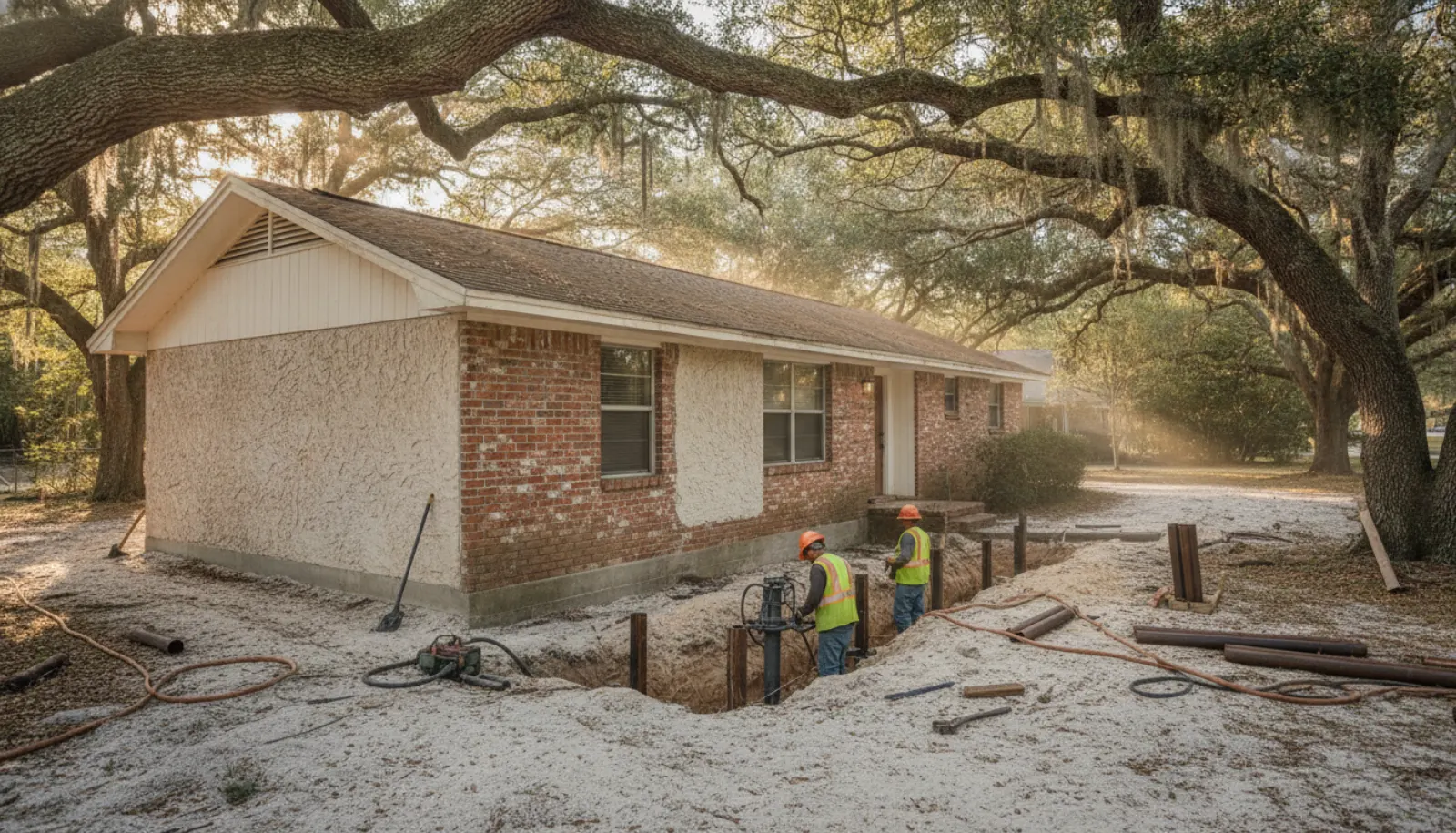
A true sinkhole near a house is a bigger job. An engineer or geologist tests the ground first. Common repairs are grout pumped deep into the ground to fill gaps and firm up the soil, and piers set under the house to hold it up. Fixr puts work on a sinking house at about $4,500 to $25,000, with piers at about $1,000 to $3,000 each. Full sinkhole grouting is priced by the job after testing. See sinkhole repair.

What to do right now

  1. Keep people and pets away. Mark the spot with stakes, tape or chairs.
  2. Do not add water or dump trash, chemicals or yard waste in the hole.
  3. Take photos from a few angles, with something for scale. Add the date.
  4. Measure it. Write down how wide and deep it is, and check again each day.
  5. Check the house. Look for new cracks, sticking doors or a jump in your water bill.
  6. Call your insurer if the hole is near the house. Florida law gives you 2 years to report a sinkhole loss after you knew or should have known about it.
  7. Report it to the Florida Geological Survey. Its helpline is 850-245-2118.

Free yard and foundation check

Call (352) 724-7728 or send the short form. A local crew will look at the spot and your house, and tell you in writing whether you need testing, a simple fill or a repair.

Frequently asked questions

Should I fill the hole with dirt?

For a small hole away from the house, the Florida Geological Survey says clean sand or soil is fine and no permit is usually needed. Do not add water. If the hole is near the house, or your insurer may need to see it, take photos and call them before you fill anything.

How do I know if it is a real sinkhole?

You often cannot tell by looking. The state says many low spots come from rotting stumps, buried debris, broken pipes or loose fill. Testing by an engineer or geologist is how a sinkhole gets confirmed.

Who do I call if the hole is in the street?

The state says to keep people away, call local law enforcement, and call the city or county road department. On a private road, the owner or the homeowners association is usually in charge.

Does my insurance cover a hole in the yard?

Florida policies must cover catastrophic ground cover collapse, which means the house itself is damaged and can't be lived in. Fuller sinkhole coverage is often an added option. A hole in the lawn alone is often not covered. Call your insurer and read your policy.

Can I report a sinkhole to the state?

Yes. The Florida Geological Survey asks people to report them so they can go into its statewide database. Its sinkhole helpline is 850-245-2118.

A low spot keeps coming back after I fill it. Why?

Something under it is still moving. It could be a rotting root, a leaking pipe or sand draining into the rock below. A spot that keeps sinking near the house should be checked.

(352) 724-7728 Free inspection