Skip to content
Gainesville Foundation

Serving Gainesville and nearby areas

Sloping or Uneven Floors in Gainesville, FL

Sloping floors in Gainesville usually mean part of the house has dropped, and a free inspection measures how much and what it takes to level it.

Book a free foundation inspection

Tell us what you are seeing. A local specialist calls you back the same business day.

Why houses move in Gainesville

Much of Gainesville sits on about five feet of sand over clay-rich soil, with limestone below that water slowly dissolves. Heavy summer storms soak the sand and wash it down into gaps in the rock. That is why the county sees sinkholes and settling under both old homes near downtown and newer slab homes on the west side.

  • Sand over clay

    USDA surveys of common Alachua County soils show sand several feet deep over a clay-rich layer, with a water table that rises to 4 or 5 feet down in wet months. Wet sand can pack down under the weight of a house.

  • Buried debris

    Alachua County lists buried building debris, old roots and leaking pipes as common reasons the ground settles. As they rot or wash out, the soil above them drops.

  • Old homes near downtown

    The City of Gainesville's historic districts hold wood frame homes going back to the 1800s. Many sit on piers over a crawl space, where floors sag as supports wear out.

What it costs

Typical published ranges for Gainesville. The contractor's written estimate is the price, and the inspection is free.

WorkTypical range
Inspection with floor level readings Free
Sagging floor repair, typicalFixr $1,000 to $8,500
Sistering a damaged joistFixr $150 to $325per joist
Piers under a sunken slabFixr 2026 $1,000 to $3,000each
Fixing a sinking or uneven houseFixr 2026 $4,500 to $25,000

See typical foundation repair prices in Gainesville

What a sloping floor feels like

A sloping floor sneaks up on you. You get used to it. Then a guest drops a marble and it rolls across the room. Or a new rug will not lie flat.

A ball or marble rolls

The same way every time.

Furniture rocks

Or leans away from the wall.

A gap opens

Under the baseboard on one side of the room.

Doors swing

Open or shut on their own.

Tile cracks

In a line across the floor.

A dip in the middle

Of the room, most of all in older homes.

A soft or bouncy spot

When you walk across it.

The floor feels "downhill"

When you walk toward one wall.

Two kinds of houses, two kinds of slope

Where the slope comes from depends on what your house sits on.

Slab homes. Most newer Gainesville homes sit on a concrete slab on the ground. Half of the city's homes were built before about 1985, so many slabs have had decades to move. A slab is stiff. When one part sinks, the whole floor tilts toward it. The slope runs in a straight line toward the low corner.

Crawl space homes. Older wood homes near downtown and the University often sit on short piers over a crawl space. Here the floor can sag between supports, like a hammock. The slope dips in the middle of a room, or along a hallway.

The fix for each is different. That is why the first step is finding out which one you have.

Why floors drop in Gainesville

The ground under Gainesville is mostly sand on top of clay, with limestone further down. USDA surveys show the water table in common local soils can rise to about 4 or 5 feet below the surface in wet months.

That mix causes slope in a few ways.

Sand packs down

A lot of water at one corner, often from a downspout, can make the sand under it settle.

Sand washes away

Water can carry sand into gaps in the limestone below. Alachua County says this is most common in very wet spells after dry ones.

Buried junk rots

The county lists old stumps, roots and building scraps left in the ground as a cause of settling. As they rot, the soil above drops.

Pipes leak

A leak under or near the slab can wash out the sand below it.

Wood wears out

In crawl space homes, damp air rots shims, sills and joists. The floor drops a little at each worn spot.

The Florida Geological Survey points out that most settling is not a sinkhole. But a slope that grows fast, or one that comes with a new hole in the yard, should be checked for one. See sinkhole repair.

Cosmetic or urgent?

Usually not urgent

  • A small slope that has been the same for years.
  • A slight dip in the middle of an old wood floor with no soft spots.

Get it checked soon

  • A slope you only started to notice in the last year.
  • A floor that feels soft or gives under your weight.
  • A slope with new cracks in walls, stucco or tile.
  • Several doors that started to stick at once.
  • A slope near a new low spot or hole outside.

How it gets leveled

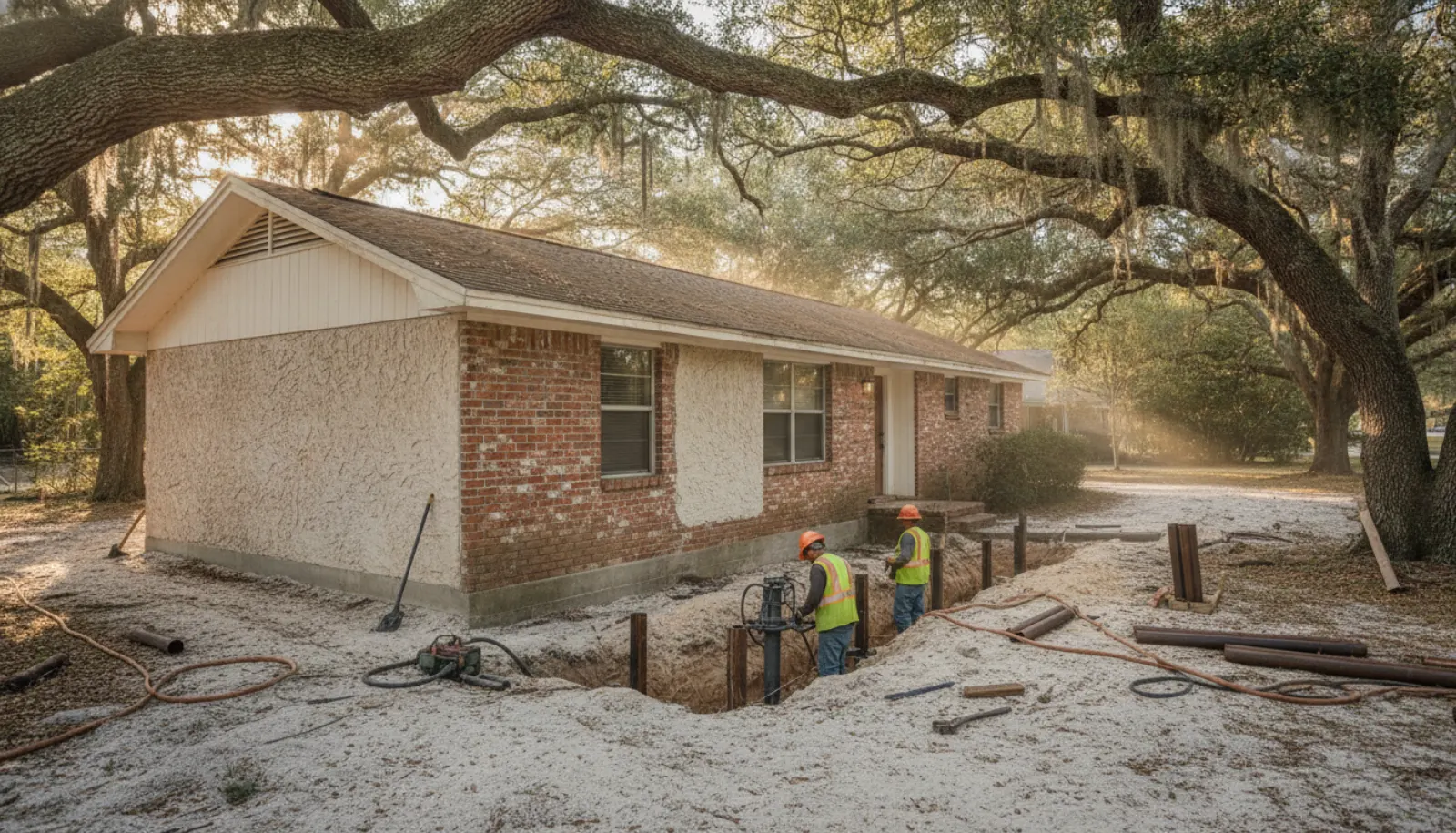
For a slab home, the usual fix is piers. The crew digs at the edge of the low area and sets steel piers down to firmer ground. Then the slab is lifted back toward level and held there. Fixr puts piers at about $1,000 to $3,000 each. Some jobs also use foam or grout pumped under the slab to fill gaps.

For a crawl space home, the crew goes under the house. Crushed shims get replaced. New steel posts go in where beams sag. Rotted joists get a new board fastened alongside, called sistering. Fixr puts typical sagging floor repairs at about $1,000 to $8,500, and sistering at about $150 to $325 per joist. See pier and beam repair.

Lifting a floor is slow on purpose. Going too fast can crack walls and pipes. Ask how much lift the crew plans and what they expect it to fix.

What to do before the inspection

  1. Roll a marble in each room and note which way it goes.
  2. Use a level or a phone level app on the worst spot. Write down the reading.
  3. Check doors in the low part of the house. Do they stick or swing?
  4. Look outside near the low corner for downspouts, standing water or a dip in the yard.
  5. If your floor feels soft, keep heavy furniture off that spot.

Free floor level check

Call (352) 724-7728 or send the short form. A local crew will take level readings across your home and give you a written plan and price.

Frequently asked questions

How much slope in a floor is normal?

Some slope is normal in any house, most of all an older one. A small dip across a big room is common. A slope you can feel when you walk, or one that keeps getting worse, is worth a check.

Can a slab floor slope, or only wood floors?

Both. In a slab home, a corner of the slab can drop when the sand under it settles. The floor tilts toward that corner. In a crawl space home, the floor sags between worn piers.

Is a sloping floor dangerous?

Usually not right away. But a floor that feels soft, gives when you step on it, or sinks fast needs help soon. So does a slope that shows up with a new hole or low spot in the yard.

Can I level my floor with self-leveling compound?

That can fix a dip in the floor surface on a slab that is no longer moving. It does not lift a slab that has sunk. If the house is still settling, the new surface will crack and tilt again.

How long does it take to level a floor?

Re-shimming a crawl space floor can take a day. Pier work under a slab home often takes one to three days. Your written estimate should list the schedule.

(352) 724-7728 Free inspection